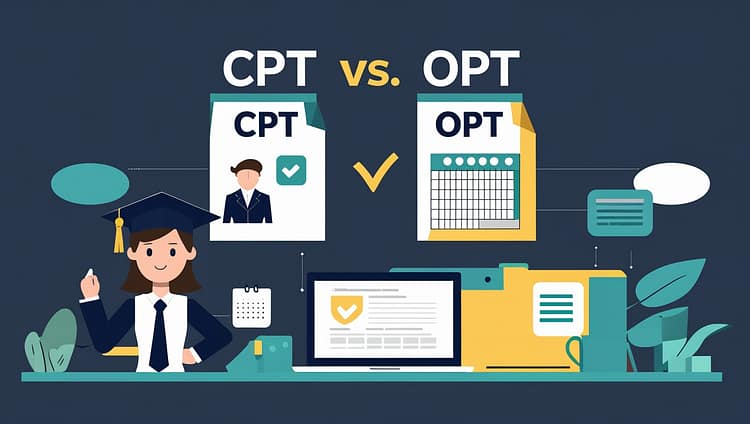
🎓 CPT vs. OPT Explained (A Student’s Real-World Guide)
Table of Contents
ToggleIf you’re an international student studying in the U.S. on an F-1 visa, chances are you’ve heard these two acronyms: CPT and OPT. But what do they actually mean—and how do you use them strategically to gain real work experience while staying compliant with immigration laws?
This guide breaks it all down in plain English, with examples, tips from past students, and a side-by-side breakdown so you don’t miss anything important.
✅ What is CPT?
Curricular Practical Training (CPT) is work authorization for F-1 students that allows you to work while you’re still in school—but here’s the catch: it has to be directly related to your major and part of your curriculum.
📌 Key Points:
You must have completed one full academic year to qualify (unless you’re a grad student in a program that requires immediate practical experience).
CPT can be part-time (20 hrs/week or less) or full-time (20+ hrs/week), depending on your school and program.
You need an internship or job offer before applying.
Your Designated School Official (DSO) will approve CPT and update your SEVIS record—no need to file with USCIS.
💡 Example:
Sara, an F-1 student majoring in Computer Science, lands a summer internship at a software company. Since her university offers a course that counts internships for credit, she gets CPT approval and works full-time during the summer.
🎯 What is OPT?
Optional Practical Training (OPT) allows you to work in your field after you finish your degree. This is where most students get their first real industry job in the U.S.
📌 Key Points:
You can use 12 months of OPT at each higher level of education (undergrad, grad, etc.).
Apply up to 90 days before and 60 days after graduation.
You’ll need to file Form I-765 with USCIS—approval usually takes 2-3 months.
You don’t need a job offer to apply—but you do need one to stay within the 90-day unemployment limit.
💡 Example:
After graduating with a B.A. in Marketing, Jay applies for OPT. He gets approved and lands a job at a digital marketing agency within 45 days of starting his OPT period.
📊 CPT vs. OPT: Quick Comparison
| Feature | CPT | OPT |
|---|---|---|
| When You Use It | During your degree | After completing your degree |
| Requires Job Offer? | Yes | No (but job must relate to field) |
| USCIS Filing? | No | Yes |
| Duration | Varies (depends on program) | Up to 12 months (plus STEM extension if eligible) |
| Can Be Paid? | Yes | Yes |
🚨 Important Things to Know
Using 12 months of full-time CPT makes you ineligible for OPT. Be strategic—ask your DSO if you’re unsure.
If you’re in a STEM field, you can apply for a 24-month OPT extension after your first 12 months.
CPT must be authorized for each specific job—you can’t just accept an offer and start working.
Your DSO is your best friend in this process. Seriously—email them, meet them, ask questions.
💬 Real Talk from a Former Student
“I rushed into CPT just because my friend got an internship. I didn’t realize it would mess with my OPT eligibility later. My advice? Plan long-term. Don’t take CPT unless it really matters to your goals.”
— Ritu, MS in Data Analytics, Class of 2023
🎁 Bonus Resource: Planning Your CPT/OPT Timeline
Here’s a simple breakdown you can follow:
📅 First Year: Focus on academics. No CPT yet.
📅 Summer After Year 1: Consider CPT if internship is credit-based.
📅 Final Semester: Apply for OPT early. Start job hunting before graduation.
✉️ Need More Help?
We’ve built a free Student Resource Hub to help international students navigate scholarships, career prep, budgeting, and more.
👉 Check out the toolkit here
🎓 Also, explore our scholarship for U.S. college students here