White-Hat Link Building Guide: How to Build Real Backlinks Without Risky Shortcuts
Table of Contents
ToggleMost businesses do not fail at link building because they ignore SEO. They fail because they choose the wrong type of link building.
White-hat link building means earning relevant backlinks through manual outreach, editorial value, and careful vetting. It is different from link seller inventory because the process starts with the client’s niche, competitors, keywords, and audience — not a prebuilt list of websites ready to sell links. A quality backlink should be relevant, indexed, useful to readers, and easy to justify.
A business owner may buy a cheap backlink package because it looks simple. An agency may approve a list of high-DR websites because the numbers look good. A startup may chase guest posts without checking whether the sites have real traffic, real readers, or any relevance to the brand.
Then a few months later, nothing meaningful happens. No stronger rankings. No real authority growth. No referral value. Sometimes, the link profile becomes harder to clean up than it was to build.
That is where white-hat link building becomes important.
White-hat link building is not about getting as many backlinks as possible. It is about earning relevant, defensible, and useful links from real websites that make sense for your business, your audience, and your long-term SEO goals. This fits Google’s broader emphasis on helpful, reliable, people-first content rather than content created mainly to manipulate rankings.
At JITEmails, we approach link building as a manual outreach and authority-building process. That means we do not start with a random list of sites ready to sell links to everyone. We start with the client’s niche, competitors, target pages, keywords, audience, and existing backlink profile.
The goal is not just to build links. The goal is to build the kind of backlink profile that looks natural, diverse, relevant, and useful when someone actually reviews it.
What Is White-Hat Link Building?
White-hat link building is the process of earning backlinks through legitimate, transparent, and value-driven methods.
That can include manual outreach, guest contributions, resource page placements, digital PR, brand mentions, local partnerships, association links, sponsorships, scholarship promotion, discount pages, niche edits where contextually appropriate, and editorial placements.
The important part is not the tactic alone. The important part is how the tactic is executed.
A guest post on a relevant industry publication can be useful. A guest post on a generic site that publishes every topic for money may not be useful.
A niche edit inside a strong, relevant article can make sense. A link inserted into a random paragraph on an unrelated site does not.
A sponsorship link from a real community organization can support trust and local relevance. A paid link on a low-quality site created only to sell placements is a very different thing. Where payment, sponsorship, advertising, or compensation is involved, link attributes and disclosure should be handled properly according to Google’s outbound link guidance.
In simple terms, white-hat link building should pass four basic tests:
- The website should be relevant or audience-aligned.
- The page should be useful and indexable.
- The link should make sense to a real reader.
- The placement should be transparent, defensible, and not built only to manipulate rankings.
A good backlink should be easy to explain.
Why this site? Why this page? Why this anchor? Why this target URL? Why would a real reader find this useful?
If those questions are hard to answer, the link probably does not belong in a quality campaign.
What White-Hat Link Building Is Not
White-hat link building is not the same as buying a random package of backlinks. Google’s spam policies specifically warn against manipulative link practices and other spam tactics that can cause pages or sites to rank lower or be omitted from Search.
- PBN links
- link farms
- automated backlinks
- profile spam
- comment spam
- forum profile links
- bulk directory submissions
- expired-domain networks
- AI-generated articles posted at scale on throwaway sites
- generic guest post sites accepting every possible niche
- public link seller lists with hundreds of ready-made placements
The problem with these links is not only that they may look low quality. The bigger problem is that they usually have no strategic reason to exist.
They are not built around the client’s audience. They are not placed because the content adds value. They are not earned through relevance or editorial fit. They are usually placed because the site exists to sell links.
That is not the type of authority most serious businesses should be trying to build.
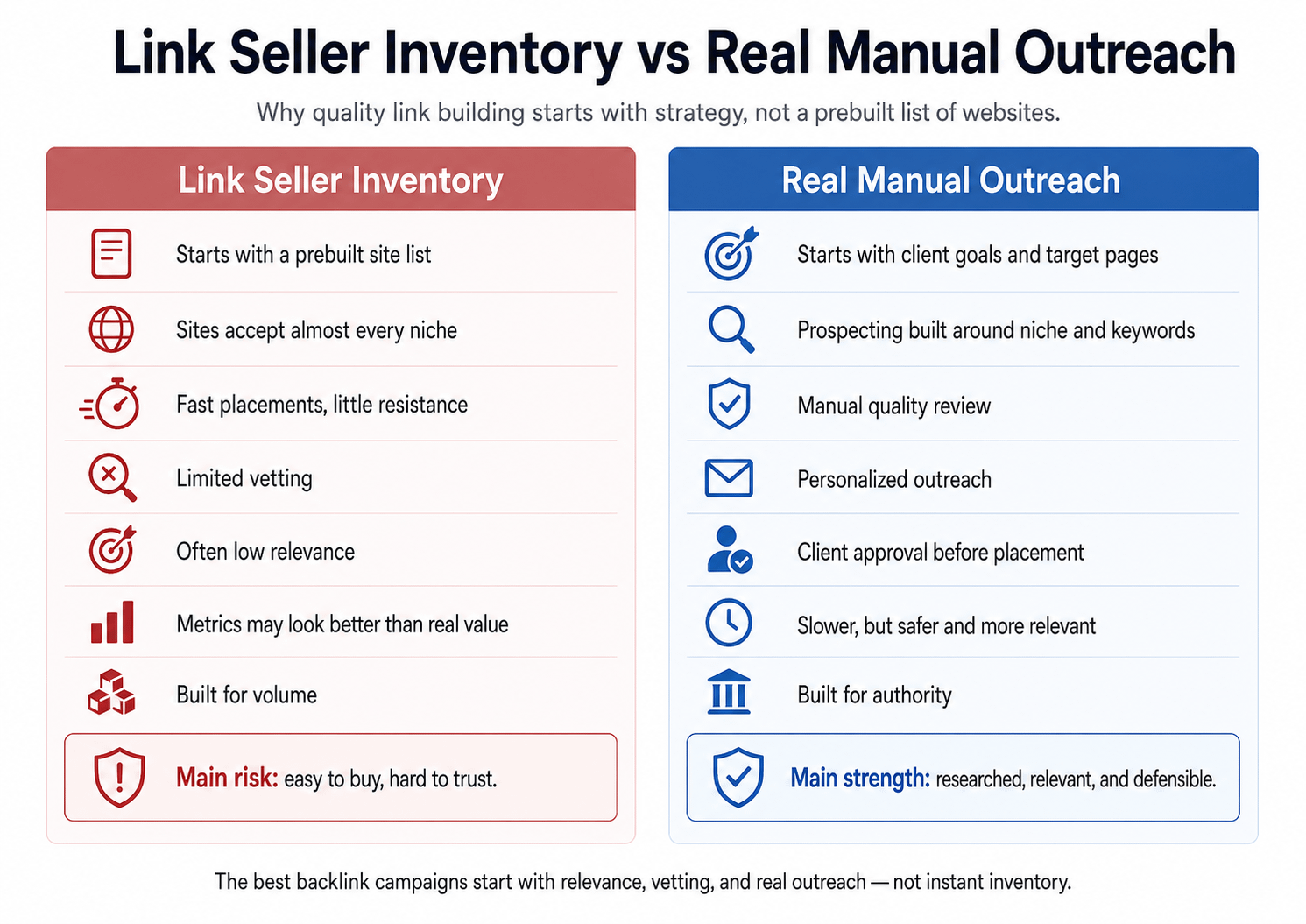
Link Seller Inventory vs Real Manual Outreach
One of the biggest misunderstandings in link building is the difference between link seller inventory and real outreach.
A link seller usually starts with a prebuilt list of websites. These sites are already willing to sell links to many different industries. To make the list look relevant to every client, these websites often create dozens of categories: business, tech, health, law, travel, pets, home improvement, finance, fashion, education, and more.
So when a client asks, “Do you have relevant websites for my niche?” the seller can point to a category and say yes.
But the real question is not whether the site has a category. The real question is whether the site has a real audience, real editorial standards, real traffic, and real topical focus.
Many link inventory sites are built mainly to monetize guest posts and link insertions. Some may show decent DA, DR, or other authority metrics for a while, but when you review them manually, the problems become clear:
- very little organic traffic
- poor keyword rankings
- unrelated content categories
- unnatural outbound links
- generic articles
- weak editorial standards
- no clear audience
- suspicious traffic patterns
- inflated authority metrics
Real manual outreach works differently. Instead of starting with a list of sites that are already selling links, we start with the client’s business and SEO goals.
Manual outreach is the process of contacting relevant websites and publishers to request or earn a backlink opportunity, and it requires research, relevance, and relationship building rather than simply selecting a site from inventory.
We look at target keywords, target pages, competitors, current backlink profile, niche relevance, local or national audience, content assets, link gaps, and realistic campaign types.
For one client, that may mean guest posts and niche edits. For another, it may mean EDU scholarship outreach. For another, it may mean sponsorships, association links, local bloggers, or resource pages. For a SaaS company, it may mean listicles, brand mentions, comparison pages, and editorial content gaps.
That is the difference. Link seller inventory asks, “Which site on this list can we place you on?” Manual outreach asks, “Which opportunities actually make sense for your business?”
White-Hat vs Grey-Hat vs Black-Hat Link Building
Not every backlink tactic fits neatly into one category, but it helps to understand the difference.
White-hat link building focuses on relevance, editorial value, transparency, and long-term authority. It usually involves manual research, real outreach, useful content, and proper quality control.
Grey-hat link building sits in the middle. These tactics may involve real websites, but the execution can become risky if links are placed mainly for rankings, if relevance is weak, or if paid placements are not handled transparently.
Black-hat link building includes manipulative tactics such as PBNs, automated links, spam comments, link farms, fake directories, and large-scale low-quality link schemes.
The safest approach is to build links that can survive a manual review. If a link looks strange when a real person reads the page, it is not a strong link.
Type | What It Looks Like | Risk Level | Long-Term Value |
White-hat | Manual outreach, editorial links, relevant guest posts, resource links | Lower | High |
Grey-hat | Paid placements on real but weakly relevant sites; overused exchanges | Medium | Mixed |
Black-hat | PBNs, automated backlinks, link farms, spam comments | High | Low/risky |

What Makes a Backlink High Quality?
A quality backlink is not defined by one metric.
A high DR link from an unrelated website with no real traffic may not be better than a lower-DR link from a focused niche site with a real audience.
When we review a backlink opportunity, we look at the whole picture. Authority metrics are useful for shortlisting prospects, but they should not replace manual review. Semrush describes Authority Score as a metric that combines link power, organic traffic, and spam signals, which supports using metrics as signals rather than absolute proof of quality.
For competitive campaigns, this review usually starts with competitor backlink profile analysis, because competitor data helps reveal which link types, pages, and authority sources are already working in the niche.
Topical Relevance
Relevance is one of the first things we check.
If the client is a moving company, a link from a relocation, home improvement, logistics, trucking, or local business website usually makes more sense than a random general news site.
If the client is a Shopify app, a link from an ecommerce, SaaS, retail, or digital marketing website is more useful than a link from a broad lifestyle blog with no connection to ecommerce.
A relevant link gives context. It helps connect the client’s website to a topic, industry, or audience.
In many cases, a relevant DR 40 website can be more valuable than an unrelated DR 80 website.
There are exceptions. A placement from a truly trusted publication such as a major business, media, or national publication can still provide brand authority and visibility even if the topical relevance is broader.
Real Organic Traffic
Organic traffic is not a perfect metric because SEO tools estimate traffic differently. Ahrefs describes its Organic Traffic metric as an estimation of monthly Google clicks, so it should be used directionally rather than treated as exact analytics data.
If a website has real organic traffic, it means search engines are sending users to its pages. That usually indicates the site has at least some visibility and value.
A site with high authority metrics but no meaningful organic traffic needs deeper review.
We usually prefer websites with at least around 5,000 estimated monthly organic visits, provided the traffic trend is stable or naturally growing. But we also make exceptions for strong niche sites with smaller but highly relevant audiences.
A small niche website can still be valuable if it ranks for quality keywords and reaches the exact audience the client wants.
Ranking Keywords
Traffic alone is not enough. We also check what keywords the site ranks for.
A site ranking for relevant, useful, topic-related keywords is much stronger than a site ranking for random, low-value, or spam-like keywords.
Keyword quality helps us understand whether the site has real topical authority.
Country and Audience Fit
Traffic source matters.
If the client is targeting the U.S. market, we want to see meaningful U.S. organic visibility.
A site may look strong in tools, but if most of its traffic comes from unrelated countries while the client needs U.S. rankings, it may not be the right fit.
The same applies to local campaigns. If a client serves Dallas, Aspen, Toronto, Vancouver, or a specific region, local and regional relevance may matter more than general authority.
Clean Outbound Link Profile
A quality website should not link out to every possible niche.
We check whether the website links to relevant, natural resources — or whether it links to casino, adult, CBD, gambling, payday loans, and hundreds of unrelated commercial sites.
An unnatural outbound link profile is one of the strongest rejection signs.
Editorial Quality
We manually review the site.
We look at content quality, authorship, publishing frequency, article categories, site layout, internal linking, editorial standards, whether the content is written for readers, and whether every article appears to exist only to host links.
Metrics can miss these things. Manual review catches them.
Page-Level Quality
A good domain does not guarantee a good page.
We check the actual page where the link will be placed.
Is the page relevant? Is the content useful? Is the link placed naturally? Is the page indexable? Is the article internally linked from the site structure? Is the link clickable? Is the anchor text correct?
A strong domain can still publish a weak guest post page. That page-level review matters.
Indexation
A link on a page that cannot be indexed may have limited SEO value.
That does not mean every non-indexed page is worthless for branding or referral purposes, but if the campaign goal is SEO, indexability matters.
Before reporting a link, we check whether the page can be found and indexed.
Traffic Trends
Stable or naturally growing traffic is usually a good sign.
Sharp unexplained drops require investigation. A traffic decline may indicate algorithmic impact, content quality issues, technical problems, or loss of search visibility.
Sharp upward spikes can also require review, especially on newer sites. Sometimes sudden growth may be artificial, temporary, or driven by low-quality traffic.
Traffic trends tell us more than a single number.
Manual Judgment
SEO tools help us shortlist opportunities. They do not make the final decision.
Metrics can be inflated. Authority scores can be manipulated. Traffic estimates can be imperfect.
Manual vetting is what helps us avoid mistakes.

Instant Rejection Signs
Some websites look good at first because the DA or DR is high. But after manual review, they clearly fail the quality test.
We instantly reject or heavily investigate a site when we see signs such as:
High Spam Indicators Combined With Weak Quality Signals
Spam Score alone is not the final decision. But if high spam indicators appear alongside weak content, poor traffic, irrelevant rankings, or unnatural outbound links, the site becomes risky.
High DA/DR but No Real Organic Traffic
A website with strong metrics but almost no Google visibility is usually not worth the investment. If search engines are not sending users to the site, we need to ask why.
Obvious Link-Selling Footprint
A contributor page is not automatically a problem. Some legitimate publications have guest contribution guidelines. The issue is when a site openly accepts almost every topic, has weak editorial standards, and appears built mainly to sell guest posts or link insertions.
Dozens of Unrelated Categories
A site that covers business, crypto, pets, law, CBD, travel, health, finance, casino, home improvement, fashion, and technology all at once may not have a real editorial focus.
Low-Value AI or Scaled Content Footprint
We do not reject a website simply because AI may have been used somewhere in the content process. The problem is when the site appears to publish large volumes of generic, unedited, low-value content created mainly for rankings or link selling. Google says appropriate AI use is not against its guidelines, but automation used primarily to manipulate rankings or produce low-value content can violate spam policies.
Suspicious Multi-Language Publishing
A multilingual site is not automatically bad. But if a website publishes unrelated posts in multiple languages with no clear audience, region, or editorial purpose, it may be a sign of mass content publishing.
Spammy Outbound Links
We reject websites that link out to casino, adult, CBD, gambling, payday loans, or unrelated spam niches.
Orphaned or Weak Pages
A link is less useful if it is placed on a page that has no meaningful internal path from the homepage, category structure, menu, or related content.
Wrong Link Behavior
A delivered link is not acceptable if the link redirects unexpectedly, is plain text and not clickable, uses the wrong anchor, points to the wrong URL, has the wrong link attribute, or is noindexed when indexation was expected.
Our White-Hat Link Building Process
Step 1: Understand the Client’s Goals
Before prospecting, we need to understand target pages, target keywords, target audience, niche, competitors, current backlink profile, country or local market, acceptable link types, monthly budget, content assets, and approval requirements.
Link building should not mean randomly sending links to the whole website. It should support specific pages, topics, and ranking goals.
Step 2: Analyze Competitors
Competitor backlink analysis helps us understand what is already working in the niche.
We look at where competitors are getting links, what types of links they have earned, which links are worth replicating, which links should be avoided, and what gaps exist between the client and competitors.
Competitor analysis is not about copying every competitor link. It is about finding patterns, identifying proven opportunities, and filling the strongest link gaps.
Step 3: Build the Opportunity Pool
We use Google search operators, competitor backlink data, target keyword SERPs, and SEO tools to build the prospect pool.
This is where diversified outreach campaigns become important, because different niches may require different link types instead of relying only on guest posts.
Depending on the campaign, we may research guest post opportunities, niche websites, resource pages, EDU resource pages, scholarship pages, discount pages, local bloggers, sponsorship pages, association directories, link roundups, review opportunities, broken link opportunities, editorial sites, brand mention opportunities, listicle placements, and business directories where relevant.
The prospecting method depends on the link type. A scholarship campaign does not use the same prospect sheet as a SaaS listicle campaign. A local sponsorship campaign does not look like a guest post campaign.
Step 4: Vet the Prospects
Raw prospect lists are never final.
If we research 400 opportunities, the usable list may shrink to 100–150 after vetting.
For larger campaigns, we have built very large opportunity pools. Past research projects have produced more than 28,000 prospects for an educational brand and more than 24,000 prospects for a transportation company across multiple link types.
But volume is not the point. The point is filtering. A large list only becomes useful after quality review.
Step 5: Find the Right Contact
The right contact depends on the website type.
For editorial sites, we may look for the writer, editor, content manager, or contributor contact.
For business websites, we may look for the owner, marketing manager, or general contact.
For scholarship, EDU, resource, or discount pages, the relevant email is often listed on the page itself.
When direct emails are not available, contact forms can still work. We use tools such as Hunter and Snov.io to find and verify emails, but we still review contacts manually where needed.
Step 6: Customize the Pitch
Personalization is not just adding a first name.
A good outreach email should show why the suggestion is relevant to that website’s audience.
We may customize emails using variables such as contact name, website name, website URL, relevant page, suggested topic, anchor text, target URL, reference content, and campaign type.
Outreach tools help manage this process at scale, but the pitch still needs to make sense. The best outreach email does not sound like a link request. It sounds like a useful contribution.
Step 7: Follow Up Professionally
Most outreach campaigns need follow-up.
We usually send two follow-ups: the first after 3–4 days and the second after 7–8 days if there is no response.
The goal is to be consistent without being aggressive.
Step 8: Negotiate Where Needed
Some websites, associations, sponsorships, or editorial opportunities may involve admin, publication, membership, or sponsorship costs.
When a cost is involved, we evaluate whether the opportunity is worth the investment based on relevance, organic traffic, audience fit, authority, placement type, content quality, previous pricing data, and client goals.
We do not approve a cost only because the site has a high DR. The opportunity still has to make sense.
Step 9: Get Client Approval
For approval-based campaigns, we do not finalize placements without client review.
We share the opportunity with the client through a Google Sheet or reporting document. The client can approve, reject, or comment.
The approval sheet usually includes website URL, link type, key metrics, relevance notes, organic traffic, placement details, cost if applicable, and our recommendation.
Step 10: Verify the Live Link
After publication, we manually check every link.
We confirm live URL, target URL, anchor text, clickable link, dofollow/nofollow status, page relevance, indexation, link placement, category placement, whether the page is internally connected, and whether the link matches the agreement.
Step 11: Report and Monitor
A link building report should make every placement easy to verify.
A proper report should include live URL, target URL, anchor text, DR/DA, organic traffic, Spam Score where relevant, placement date, link type, dofollow/nofollow status, cost, indexation status, and notes/comments.
We update reporting documents as opportunities progress. Clients usually review reports weekly. Some slower campaigns, such as EDU scholarship or resource outreach, may move on a monthly rhythm because schools and universities often update pages every few weeks.
If a link is removed later, we contact the editor or publisher again. If they do not respond after several follow-ups, the opportunity may be treated as inactive or lost and handled case by case.

White-Hat Link Building Strategies That Still Work
A strong diversified link building strategy combines multiple relevant link types so the backlink profile looks more natural, balanced, and defensible.
Guest Posts
Guest posting works when the site is relevant, the content is original, and the article provides value to the publication’s audience.
Good guest posting is not about publishing thin content anywhere that accepts it.
A good guest post should match the site’s audience, cover a useful topic, include natural links, meet editorial standards, avoid over-optimized anchors, and be placed on a site with real traffic and relevance.
Bad guest posting is easy to spot. The site accepts every topic, publishes low-quality articles, and exists mainly to sell links.
Niche Edits / Link Insertions
A niche edit can be useful when a link is added to an existing relevant article in a way that improves the content.
The key is context. If the link naturally supports the article and helps the reader, it may be a good opportunity. If the link is forced into an unrelated paragraph, it is weak.
Resource Page Links
Resource pages can be strong when the client has something genuinely useful to offer.
That could be a guide, checklist, calculator, scholarship, template, industry resource, discount page, or research report.
Resource outreach works best when the resource deserves to be listed.
EDU Scholarship Links
Scholarship outreach can work when the scholarship is real.
A proper scholarship page should include scholarship name, award amount, eligibility, application instructions, deadline, winner announcement date, contact email, and business information.
A minimum award of around $500 is a practical starting point, but a higher award can improve credibility.
Scholarship link building should not start with “we need EDU links.” It should start with a real scholarship that helps students.
EDU Discount Links
Discount links can work for businesses that genuinely offer discounts to students, staff, faculty, alumni, or military audiences.
This can work for moving companies, transportation companies, delivery services, rental companies, ecommerce stores, clothing brands, jewelry brands, and custom product businesses.
Typical discounts may range from 10% to 30%, depending on the business.
For service companies, a dedicated discount landing page is usually helpful. For ecommerce sites, clear discount details and a valid store/category page may be enough.
A good discount listing can sometimes bring more than a backlink. It can also generate real inquiries from students, staff, faculty, or eligible community members.
Sponsorship Links
Sponsorship links can be useful when the sponsorship is real and relevant.
Examples include local events, nonprofits, industry organizations, clubs, community initiatives, educational programs, and niche associations.
The link should represent a real relationship, not just a link purchase.
Association and Membership Links
Industry associations can be very valuable for certain niches.
For a nationwide transportation client, we pursued association opportunities where the client could be listed as a member, sponsor, vendor, or partner.
These opportunities can include member directory links, vendor listings, partner pages, sponsor pages, event pages, and homepage logo/banner links.
Many associations require business verification, licensing, location details, industry fit, or other proof before accepting a company. That vetting is part of what makes the link more trustworthy.
These links do not always guarantee traffic, but they can add trust, niche relevance, and diversity to the backlink profile.
Local Links
Local links are especially useful for local businesses.
Examples include local bloggers, chambers of commerce, local directories, city resource pages, local sponsorships, community organizations, local events, and local business associations.
For local SEO, a relevant local link can sometimes be more useful than a random national guest post.
Brand Mentions and Editorial Links
Sometimes the best link is not a guest post at all.
It may be a brand mention, expert quote, author profile, editorial citation, or business feature.
These links are harder to control, but they can be powerful because they are earned through relevance, expertise, or editorial usefulness.
Bylined Articles and Author Profile Links
Some strong websites do not add links directly inside articles, but they may include the author’s website in the profile or contributor bio.
These links can still support brand authority, especially when the publication is trusted and has real organic traffic.
Digital PR and Expert Quotes
Journalist request platforms and PR-style opportunities can produce strong links when the expert response is specific, relevant, and useful.
These opportunities are not guaranteed. Editors receive many responses, and generic answers rarely stand out.
The best quotes sound like they came from someone who has actually done the work.
Broken Link Building
Broken link building works when you find a dead or outdated resource that has backlinks, create or suggest a relevant replacement, and contact sites linking to the broken page.
Ahrefs describes the process as finding broken pages with backlinks, vetting opportunities, creating a replacement page, and doing outreach.
It can be effective, but it requires a useful replacement page and a strong reason for the publisher to update the link.
Link Roundups
Link roundups can work in some niches, especially when the content asset is genuinely useful.
But they are usually lower response-rate campaigns and should not be treated as a guaranteed link source.

Real Examples of Diversified White-Hat Link Building
You can also review our real outreach case studies to see how diversified campaigns work across education, transportation, authority building, and niche outreach projects.
Association Links for a Transportation Client
For a nationwide transportation company, we researched associations and industry organizations in trucking, moving, logistics, and transportation.
Some organizations added the business as a member. Others listed it as a sponsor, vendor, or partner.
Depending on the association, the link could appear on a member directory, vendor page, partner page, event sponsor page, homepage logo section, or banner placement.
These were not instant links. Many required business details, licensing, location information, and industry fit.
Some memberships or sponsorships involved annual fees. The value was not only the backlink. The value was the industry affiliation, community trust, and backlink diversification.
Discount Links for Moving and Service Businesses
Discount outreach can work well when a business offers a real discount to a real audience.
For a moving company, university and alumni discount pages created both backlinks and real inquiries from students, staff, and faculty.
This matters because the link is not just an SEO asset. It also puts the business in front of people who may actually need the service.
For service businesses, a dedicated discount page is usually useful because there may not be a traditional checkout process. The page can explain eligibility, discount amount, how to claim it, and contact details.
For ecommerce businesses, clear discount details and a store or category URL may be enough.
Scholarship Links from EDU Resource Pages
Scholarship outreach works when the scholarship is genuine and student-focused.
Universities and colleges usually review the scholarship page before listing it. They may ask for award amount, eligibility, application URL, deadline, contact person, business details, and winner announcement date.
A dedicated scholarship landing page makes this process easier.
The strongest scholarship campaigns are not built around “getting EDU links.” They are built around offering a real scholarship that schools can confidently share with students.
Editorial Links from Content Gaps
Some good editorial websites do not charge money. They link when the content is relevant, useful, and fills a gap for their audience.
These are hard to earn because the site cares about quality.
For example, if a publication is writing about sustainable moving, auto transport technology, relocation planning, or a related topic, a transportation client may be a natural expert source or reference.
The outreach angle matters. The pitch should not say, “Please give us a backlink.” It should explain why the client’s expertise or resource improves the article.
Bylined Author Profile Links
Some trusted publications do not allow promotional links inside the article body, but they may allow a link in the author profile.
These links can still support brand authority and diversification.
They are usually harder to earn because the publication has editorial standards. But when the site is relevant and trusted, the effort can be worth it.
PR / Expert Q&A Links
Expert quote opportunities can create strong editorial mentions when the answer is genuinely useful.
This is not a predictable link quota channel. Many pitches will not convert.
But when the response is specific, timely, and based on real experience, it has a much better chance of being included.
Reporting and Quality Control
A link is not complete just because a publisher says it is live. It needs to be checked.
Before reporting any placement, we manually verify the live URL, target URL, anchor text, link placement, clickability, dofollow/nofollow status, indexation, page relevance, category relevance, and whether the page is connected to the site structure.
A delivered link is not acceptable if it redirects unexpectedly, appears as plain text, points to the wrong URL, uses the wrong anchor, sits in an irrelevant category, or appears on an orphaned page with no meaningful internal path.
A good report should be transparent enough that the client can verify every placement.
The report should not only show what went live. It should show that each placement was checked and still meets the agreed quality standard.
Report Field | Why It Matters |
Live URL | Allows the client to verify the placement |
Target URL | Confirms the correct page received the link |
Anchor text | Helps monitor anchor diversity and accuracy |
Link type | Guest post, niche edit, resource link, sponsorship, etc. |
DR / DA | Gives authority context |
Organic traffic | Shows whether the site has search visibility |
Spam Score | Helps identify risk signals |
Dofollow / nofollow | Confirms the agreed link attribute |
Placement date | Tracks delivery timeline |
Cost | Keeps third-party costs transparent |
Indexation status | Shows whether the page can be discovered |
Notes | Explains relevance, placement quality, or concerns |
Common Client Mistakes and Misunderstandings
Mistake 1: Asking for Manual Outreach but Expecting Ready-Made Lists
A client may say they want manual, white-hat outreach, but then ask, “What sites do you already have available?” That usually comes from link seller inventory thinking.
Manual outreach does not start with what is already available. It starts with what is relevant and worth pursuing.
Mistake 2: Expecting High Quality With a Very Low Budget
Quality links take time and budget.
If a client asks how many strong links can be built in five hours per week, the answer may be difficult. Prospecting, vetting, email finding, outreach, follow-ups, negotiation, approval, content, QA, and reporting all take time.
Mistake 3: Expecting Authority Growth Immediately
Some clients ask how quickly a new website can grow from zero authority to a strong DA/DR score.
Authority growth is gradual. Links can support rankings, but they are not the only factor. Content quality, technical SEO, topical coverage, competition, and time all matter.
Mistake 4: Pushing Exact-Match Anchors Too Aggressively
Some clients want exact-match anchors because they believe it will help them rank faster.
A safer anchor profile usually includes a mix of branded, partial-match, URL, natural phrase, and selective keyword anchors. Too many exact-match anchors can make a link profile look unnatural.
Mistake 5: Ignoring Relevance
A high-metric backlink is not automatically a good backlink.
If the link has no topical or audience connection, it may provide limited value. Relevance gives the link context.
Mistake 6: Comparing Manual Outreach With Cheap Link Packages
Cheap link packages are faster because the sites are already waiting to sell links.
Manual outreach is slower because the opportunity has to be found and earned. These are not the same service.
Mistake 7: Weak Content or Target Pages
Backlinks cannot fix weak pages by themselves.
If a target page is thin, incomplete, poorly written, or not useful, link building will have limited impact. Strong links work best when they point to pages that deserve to rank.
Mistake 8: Thinking Link Building Means Guest Posts Only
Guest posts can be useful, but they should not be the whole strategy.
A stronger backlink profile may include guest posts, resource links, association links, sponsorships, EDU links, local links, brand mentions, and editorial mentions.
The best clients understand this. They may approve fewer links, but they do not compromise on quality.
When Is a Business Ready for Link Building?
A business is ready for link building when the website foundation is strong enough to benefit from authority building.
Before investing heavily in backlinks, the website should be complete, responsive, technically stable, fast enough on mobile and desktop, free from major broken links, free from important noindex issues, connected to Google Analytics and Search Console, supported by keyword research, and mapped against at least one strong competitor.
Target pages should be ready. That means product pages, service pages, location pages, resource pages, and pillar pages should already have useful content.
Internal linking should also be in place. Important pages should not be buried. They should be accessible through the homepage, navigation, footer, category pages, or relevant supporting content.
A business is usually not ready for link building if the website is incomplete, target pages are thin, on-page SEO is not done, technical issues are unresolved, keyword priorities are unclear, there are no strong resources to promote, the client expects instant rankings, or the client only wants the cheapest links possible.
Backlinks amplify the strength of a website. They do not replace the need for strong pages, clear targeting, and useful content.

Why Quality Link Building Costs More
Cheap link packages can offer links for extremely low prices because the sites are already available to almost everyone. Ahrefs separates link acquisition into buckets such as add, earn, ask, and buy, and notes that buying backlinks is risky.
The turnaround can be fast because there is little resistance: no deep research, no serious vetting, no real outreach, no negotiation, no quality control, and no strategy.
Manual link building costs more because it involves real work.
A quality campaign may require competitor analysis, prospect research, manual vetting, email discovery, email verification, outreach setup, customized email copy, follow-ups, reply management, negotiation, content outlines, content writing or editing, publisher communication, client approvals, live link QA, reporting, and monitoring.
There are also separate cost categories. Outreach management covers the research, prospecting, vetting, outreach, negotiation, approvals, QA, and reporting. Content creation is separate when the client needs articles, outlines, edits, or revisions. Third-party fees are also separate when a publisher, association, sponsor, or organization charges admin, editorial, membership, sponsorship, or publication costs.
In some campaigns, outreach management may cost around $1,000–$2,500 per month, depending on the niche, campaign size, and link goals. Content and third-party fees are separate and depend on the campaign.
The point is not that every campaign needs the same budget. The point is that quality link building has real operational costs.
A $1 backlink is not cheap if it adds no authority, no relevance, no traffic, and future cleanup risk.
Strong Expert Takeaways From Years of Link Building
Relevance Usually Beats DR
A relevant link from a niche website often provides more value than a stronger-looking link from an unrelated domain. Authority matters, but relevance gives the link meaning.
Cheap Links Can Become Expensive Later
Cheap links may save money upfront, but they often provide little long-term value. If the links are poor, irrelevant, or risky, the business may later need cleanup.
Quality Links Take Time
A good backlink campaign involves research, outreach, vetting, negotiation, content, approval, QA, and reporting. That cannot be rushed without lowering quality.
Outreach Is Relationship Building
Outreach is not just sending emails. It is about understanding the publisher’s audience and offering something useful.
A Link Should Make Sense to a Real Reader
If a link only makes sense to an SEO tool, it is not a strong link. The best links help the reader.
Diversification Matters
A backlink profile built only on guest posts can look limited. A stronger profile includes multiple link types from different relevant sources.
Link Building Cannot Fix Weak Content Alone
Backlinks support authority, but they cannot make poor content valuable. Target pages must be worth promoting.
Manual Vetting Matters More Than Tool Metrics
Tools help us shortlist sites. Manual review helps us avoid mistakes. Metrics can be manipulated. Human judgment is still necessary.
Consistency Wins
Link building is not a one-month fix. The best results usually come from consistent, quality-focused outreach over time.
Final Thoughts
White-hat link building is slower than buying cheap links, but it is also more defensible.
A good backlink should not feel random. It should fit the website, the page, the reader, the anchor text, and the client’s business.
Before approving a link, ask: Is this website relevant? Does it have real organic visibility? Does it rank for meaningful keywords? Is the page useful? Is the link placed naturally? Would this make sense to a real reader? Can we explain why this link belongs here?
If the answer is yes, the link is much more likely to support long-term authority. If the answer is no, the link probably does not belong in a quality campaign.
White-hat link building is not about chasing every possible backlink. It is about building a stronger, safer, and more diversified backlink profile through real outreach, useful content, careful vetting, and transparent reporting.

Need a Diversified Link Building Campaign?
Need a diversified link building campaign built around real outreach, relevance, and quality? JITEmails helps businesses and SEO agencies build stronger backlink profiles through guest posts, niche edits, EDU links, sponsorships, association links, resource links, brand mentions, and editorial outreach.
If you want safer, more relevant backlinks from real websites, contact JITEmails to discuss a custom diversified link building campaign.

About the Author
Noman Yousaf is an outreach and link building specialist at JITEmails. He has worked on manual outreach, EDU link building, diversified authority campaigns, guest post prospecting, niche edits, sponsorship outreach, association links, and competitor backlink gap analysis across industries including transportation, education, ecommerce, legal, SaaS, and local services.